

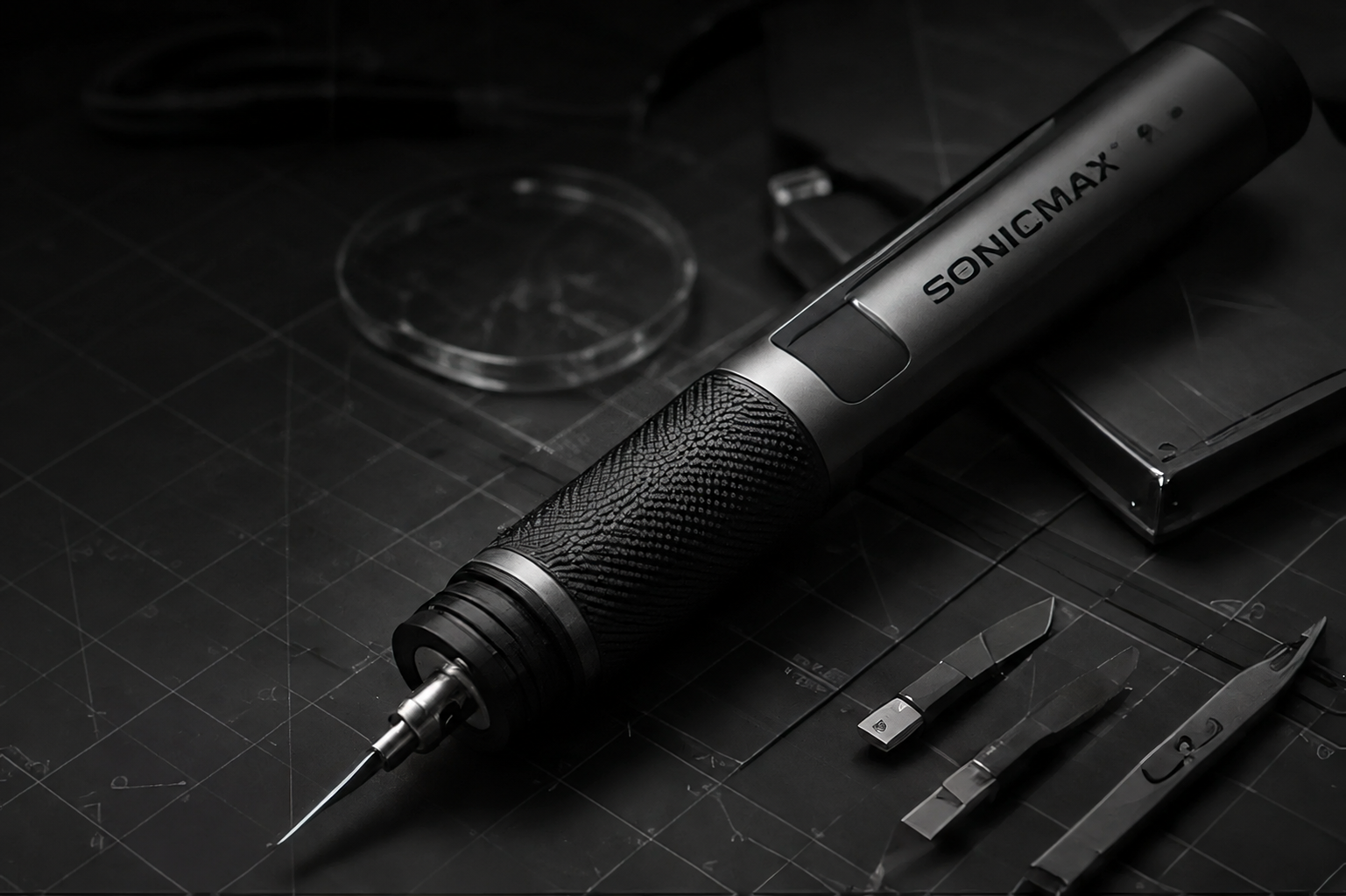
Short answer: An ultrasonic cutter is a powered cutting tool that moves a blade back and forth at an ultrasonic frequency. Instead of relying only on hand pressure, those rapid microscopic movements help the blade pass through suitable materials with less drag. For makers, that can mean more control when trimming 3D print supports, shaping EVA foam, cleaning model parts, or cutting thin craft materials. It is still a sharp powered tool, and the result depends on the material, blade, cutting speed, and technique.
Ultrasonic cutters are becoming more familiar in maker workshops because they sit between two traditional options: the simplicity of a hobby knife and the power of a larger rotary or heated tool. Understanding how they work helps you decide where they add real value, where a normal knife is enough, and where another tool is the safer choice.
What Is an Ultrasonic Cutter?
An ultrasonic cutter uses a small blade connected to a vibrating system inside the handle. When activated, the blade moves at a frequency above the normal range of human hearing. The movement is extremely small, so the tool does not look like it is sawing back and forth. At the cutting edge, however, those fast movements help reduce resistance between the blade and the material.
The result is not magic and it is not a laser. The blade still needs a cutting path, a suitable angle, and controlled contact with the workpiece. The difference is that the tool supplies much of the repeated motion that would otherwise come from greater hand force.
How Does Ultrasonic Cutting Work?
A typical ultrasonic cutting system has four functional parts:
- Power source: supplies electrical energy to the tool.
- Ultrasonic driver and transducer: convert electrical energy into high-frequency mechanical vibration.
- Blade holder: transfers that vibration to the cutting blade.
- Blade: concentrates the motion at a narrow cutting edge.
On SonicMax Slice 10, the blade operates at 40,000 vibrations per second. The motion is small but fast. When the edge touches a compatible material, the vibrating blade repeatedly breaks contact at a microscopic level. This can reduce drag and the amount of continuous pressure needed to advance the cut.
Lower required force matters most around delicate details. A hard push with a manual knife can flex a thin printed wall, snap a small model feature, compress foam, or cause the blade to jump when it finally breaks through. An ultrasonic cutter can make those same operations more controlled, although the user still needs to stabilize the part and keep hands away from the cutting path.
What Does an Ultrasonic Cutter Feel Like to Use?
The most noticeable difference is usually resistance. A hobby knife depends mainly on blade sharpness, leverage, and the pressure applied by the user. An ultrasonic cutter adds powered vibration, so the blade may feel as though it is gliding through the material rather than being forced through it.
That does not mean every cut should be fast. Slow, deliberate passes are often better for accuracy. Several light passes can also be more controlled than trying to cut the full depth in one movement. The goal is not to push harder; it is to let the blade do the work while you guide the direction.
Where Are Ultrasonic Cutters Most Useful?
1. Removing 3D Print Supports
Support removal is one of the clearest maker use cases. Supports near wings, rails, fingers, thin walls, or recessed areas can be difficult to reach with flush cutters. Pulling or twisting them may damage the model. An ultrasonic blade can help separate individual contact points with less force.
It does not replace good slicer settings. Support density, interface layers, orientation, and material condition still determine how cleanly a print releases. For a complete workflow, see our guide on how to remove 3D print supports cleanly.
2. Cleaning Plastic Model Parts
Parts attached to runners or sprues often need close trimming before sanding and assembly. The powered blade can help cut near the attachment point while reducing the stress placed on a small part. Leave a tiny amount of material when necessary, then finish the surface with a file or fine abrasive rather than cutting directly into a visible face.
3. Shaping EVA Foam and Foam Board
Cosplay builders, prop makers, and architectural modelers often need curves, notches, bevels, and repeated detail cuts. Foam can compress or tear when a dull manual blade is dragged through it. A sharp ultrasonic blade may reduce that drag and help preserve the intended shape.
Always test a scrap from the same sheet first. Foam density, coatings, adhesive layers, and thickness can change the result. Our material compatibility guide explains why different plastics and foams behave differently.
4. Leather and Soft Craft Materials
For suitable leather and soft sheet materials, an ultrasonic cutter can help with short detail cuts, corners, and trimming around a pattern. A cutting mat and a stable straightedge are still important. Thick, layered, reinforced, or coated materials should be tested before committing to a finished piece.
5. General Maker Post-Processing
An ultrasonic cutter works best as part of a tool set. Flush cutters may be faster for open supports. A hobby knife may be simpler for paper-thin trimming. Files, sanding sticks, deburring tools, and filler primer handle finishing jobs that no cutting blade should attempt. See our comparison of post-processing tools for makers and model builders for a broader workshop setup.
Ultrasonic Cutter vs. Hobby Knife
| Task factor | Ultrasonic cutter | Hobby knife |
|---|---|---|
| Cutting force | Powered vibration can reduce drag on compatible materials | Depends on hand pressure and blade sharpness |
| Control near delicate details | Useful when lower force helps protect the part | Good for light scoring and simple trimming |
| Setup | Requires power, correct blade installation, and operating checks | Simple and immediately ready |
| Heat | Heat can build during long or aggressive cuts | No powered heat source, though friction still occurs |
| Best fit | Repeated cleanup, detailed models, foam shaping, and difficult support contacts | Occasional cuts, scoring, paper, and simple craft work |
| Safety | Sharp powered blade; requires deliberate handling | Sharp manual blade; slipping and excess force remain risks |
Neither tool wins every task. The practical choice depends on material, access, finish requirements, and how often the work is repeated. Read the full ultrasonic cutter vs. hobby knife comparison for more detail.
Does Ultrasonic Cutting Create Heat?
Yes, heat can still develop. Ultrasonic cutting reduces some forms of drag, but energy is still being transferred through the transducer, blade holder, blade, and material. Long continuous cuts, excessive pressure, a worn blade, or a poor match between tool and material can increase heat.
This is why cutter design matters. Slice 10 combines a high-efficiency ultrasonic system with active cooling and power control intended to reduce heat buildup during maker workflows. Cooling does not remove the need for correct technique. If the tool or material begins behaving differently, pause and inspect the blade, cut, and workpiece before continuing.
How to Test a New Material
- Check the material first. Avoid metal, glass, ceramic, carbon-fiber sheet, thick epoxy board, and composites containing metal layers unless the manufacturer explicitly approves them.
- Use a scrap piece. Test the exact material, thickness, coating, and adhesive construction.
- Install a clean, sharp blade. A worn blade increases force and makes results harder to evaluate.
- Start with a short, shallow cut. Watch for melting, tearing, smoke, odor, discoloration, or unexpected resistance.
- Adjust technique, not just force. Change the angle, speed, or number of passes rather than pushing harder.
- Inspect the edge. Decide whether the result is suitable before cutting the actual project.
Common Mistakes to Avoid
- Treating the tool like a saw: rapid arm movement usually reduces accuracy.
- Using a dull blade: powered vibration cannot make a damaged edge precise.
- Forcing a deep cut: multiple controlled passes are often cleaner.
- Skipping material tests: plastics with similar names can behave differently.
- Holding the part in the cutting path: use clamps, fixtures, or a safe grip position.
- Expecting a finished surface immediately: cutting and surface finishing are separate steps.
- Ignoring heat or odor: stop if the material reacts unexpectedly and improve ventilation.
Frequently Asked Questions
Is an ultrasonic cutter the same as a hot knife?
No. A hot knife uses heat as the primary cutting mechanism. An ultrasonic cutter uses high-frequency blade vibration. Heat can still develop during use, but it is not the main operating principle.
Can an ultrasonic cutter cut any plastic?
No. Results depend on plastic type, geometry, thickness, additives, and technique. PLA, PETG, resin supports, and some plastic sheets may be suitable for particular cleanup tasks, but every new material should be tested first.
Will it replace flush cutters and sanding tools?
No. Flush cutters are efficient for accessible supports, and sanding tools are better for smoothing marks and preparing a finish. An ultrasonic cutter adds control for specific cuts; it does not replace the rest of the post-processing workflow.
Is an ultrasonic cutter safer than a hobby knife?
It may require less pushing force, which can improve control in some tasks, but it remains a sharp powered blade. Safe hand placement, eye protection where appropriate, a stable work surface, and careful material testing are still necessary.
Why does blade sharpness matter if the tool vibrates?
The vibration assists the cutting action, but the edge still creates the cut. A damaged or dull blade increases resistance, heat, and the chance of an uneven result.
Can I use one for detailed 3D-printed models?
Yes, detail cleanup is a strong use case when supports or runner connections sit near fragile features. Stabilize the model, work one contact point at a time, and leave final surface refinement for files or abrasives.
What frequency does Slice 10 use?
Slice 10 operates at 40kHz, or 40,000 vibrations per second. It also includes active cooling, smart power control, a replaceable 5000mAh 21700 battery, and a built-in LED for detailed work.
When should I choose a normal knife instead?
A sharp manual knife is often enough for occasional light scoring, paper, masking material, or simple trimming. An ultrasonic cutter becomes more useful when you repeatedly work with detailed models, difficult supports, foam shaping, or cuts where lower force improves control.
Final Takeaway
An ultrasonic cutter turns electrical power into extremely fast blade movement. That movement can reduce cutting resistance and help makers guide a sharp edge with less force through compatible materials. Its real advantage is not that it replaces every workshop tool. It gives creators another level of control for detailed cleanup, foam shaping, model work, and repeated post-processing.
The best results still come from matching the tool to the task: use a sharp blade, stabilize the workpiece, test unfamiliar materials, make controlled passes, and finish the surface with the appropriate file or abrasive.
Learn more about SonicMax Slice 10 and follow the latest launch updates.
Share:
Best Post-Processing Tools for Makers and Model Builders
Last Call: What the $1 Early Bird Reservation Means for SonicMax Slice 10